
Content Marketing Funnel?
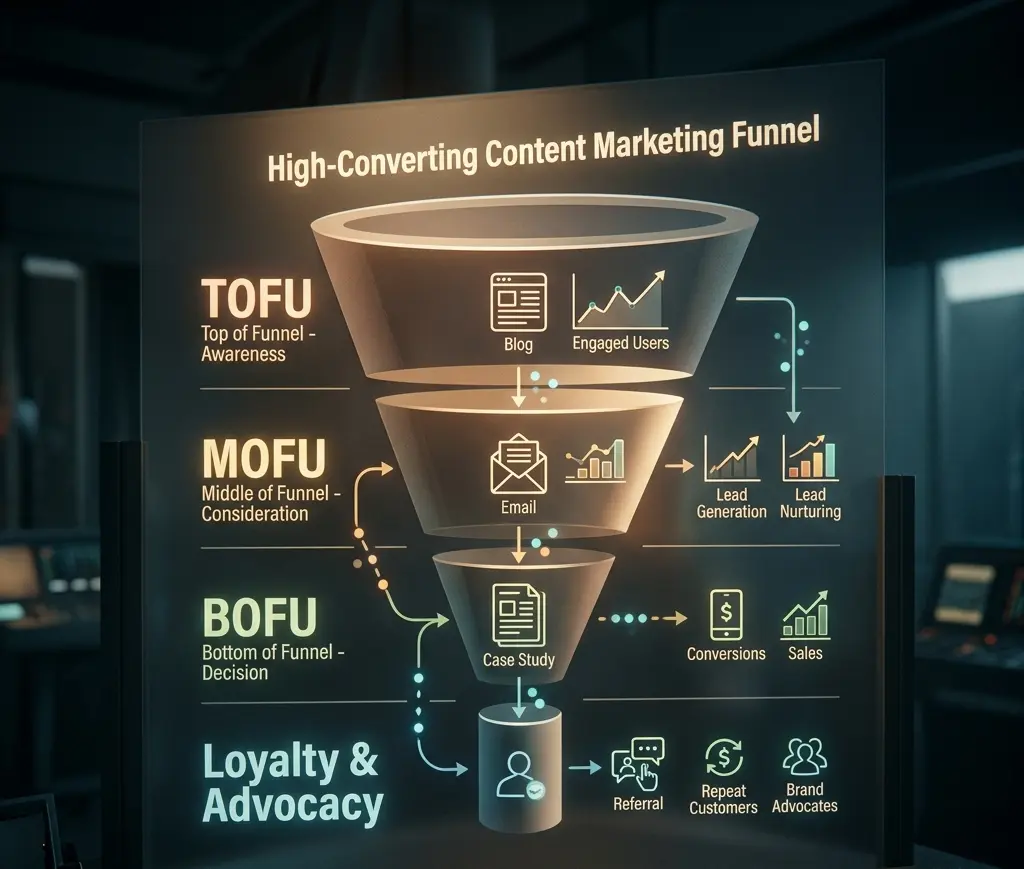
Master Guide: Building a High-Converting Content Marketing Funnel Traffic alone means very little when it doesn’t lead to significant action, because traffic without conversion is just a vanity metric that looks good on reports but does nothing for company expansion. The true problem many organisations face today is that they constantly invest time and resources in content generation while failing to generate a tangible return on investment (ROI), leaving them unhappy with ineffective campaigns and inconsistent outcomes. The main problem is not a lack of content, but a lack of direction. The solution lies in a methodical approach to mapping content to the buyer’s journey, guaranteeing every piece of content fulfils a clear purpose—from understanding to consideration to conversion. This is precisely where tactical planning makes the difference, and at The Leeway Media, a leading digital marketing agency in Kerala, we concentrate on creating content marketing funnels that don’t just captivate audiences but guide them effortlessly toward action through purposeful content design and distribution. What is a Content Marketing Funnel? A content marketing funnel is a strategic model that depicts a potential customer’s path from their first engagement with a brand to the last stage of completing a purchase—and beyond, to long-term loyalty and advocacy. It aids companies in comprehending how to lead individuals step-by-step with tailored information that aligns with their attitude at every turn. At the top of the funnel, customers are simply identifying a problem or becoming aware of a brand for the first time. Here, the purpose of the information is to inform, educate, or draw attention. The information becomes increasingly thorough, trust-building, and solution-focused when consumers enter the center of the funnel and start weighing possibilities and comparing solutions. Finally, at the bottom of the funnel, customers are ready to make a decision, and the material here emphasises persuasion, clarity, and a conversion-driven message. The funnel does not end with purchase; it continues into post-buy interaction, where content fosters customer pleasure, stimulates repeat business, and converts customers into loyal advocates who actively promote the brand. In essence, a content marketing funnel visually reflects the complete relationship-building process between a company and its audience, ensuring that each piece of content plays a specific purpose in driving consumers closer to conversion and long-term loyalty. Why Your Business Needs a Content Marketing Funnel A content marketing funnel is no longer optional for businesses that want consistent growth—it is the backbone of a system that turns random content efforts into measurable results. Without a funnel, content frequently functions in isolation, grabbing attention but failing to direct potential buyers to a specific next step. With a planned funnel in place, each piece of content has a specific purpose in pushing prospects along, making your marketing far more strategic and effective. A major benefit is improved lead nurturing. Instead of losing potential customers after their first interaction, a funnel helps you consistently engage them with the right content at the right time, establishing confidence gradually until they are ready to buy. This naturally leads to increased conversion rates since prospects are not just discovering your brand; they are also being informed, reassured, and guided toward a structured decision. Shortening sales cycles is another benefit of a well-designed funnel. When customers receive accurate information at each point of their journey, they spend less time hesitating and more time taking action, eliminating friction in the decision-making process. Over time, this approach also enables automated client acquisition, in which strategically designed content attracts, nurtures, and converts leads with minimal manual involvement, resulting in a scalable growth engine for the company. The Three Core Stages of a Content Marketing Funnel A content marketing funnel is often divided into three primary stages: TOFU, MOFU, and BOFU, each indicating a distinct level of awareness and intent in the customer’s journey. When combined, these phases assist companies in guiding prospective clients from first-time brand discovery to a confident purchase decision. At the Top of the Funnel (TOFU), the goal is to draw attention and raise awareness. This is where consumers are just starting to identify an issue or investigate a subject, so the information is meant to be instructive, informative, and accessible to a broad audience. Moving into the Middle of the Funnel (MOFU), the audience becomes more engaged and begins to consider potential solutions. At this point, the material starts to focus on developing trust, providing more in-depth analysis, and establishing the brand as a reliable source of solutions. Finally, at the Bottom of the Funnel (BOFU), the audience is very intent-driven and close to making a decision, so material here is geared toward conversion—addressing objections, demonstrating proof, and reiterating why your solution is the best option. Knowing these three phases is crucial because it guarantees that your content strategy is in line with how actual customers think, assess, and make decisions rather than being arbitrary. Demystifying the Top of the Content Marketing Funnel The Top of the Content Marketing Funnel (TOFU) is the awareness stage, where your audience is just starting to identify a problem, explore a topic, or search for general information—not solutions. They are not yet ready to buy, and attempting to sell immediately typically pushes them away rather than attracting them. The basic purpose of TOFU content is to connect rather than convert. It focuses on teaching, entertaining, and informing people in a way that helps them better understand their problems while quietly establishing your business as a useful and trusted source of knowledge. This is where businesses create first impressions by providing useful information such as blogs, social media postings, videos, infographics, and guides that answer broad queries and pique interest. Instead of promoting a product or service, TOFU content builds trust at an early stage. It presents your brand as an authority that is aware of the problems that the audience faces and is prepared to deliver value without demanding anything right now. When executed properly, this phase raises awareness of both the issue and your brand as a reliable