Master Guide: Building a High-Converting Content Marketing Funnel
Traffic alone means very little when it doesn’t lead to significant action, because traffic without conversion is just a vanity metric that looks good on reports but does nothing for company expansion. The true problem many organisations face today is that they constantly invest time and resources in content generation while failing to generate a tangible return on investment (ROI), leaving them unhappy with ineffective campaigns and inconsistent outcomes. The main problem is not a lack of content, but a lack of direction. The solution lies in a methodical approach to mapping content to the buyer’s journey, guaranteeing every piece of content fulfils a clear purpose—from understanding to consideration to conversion. This is precisely where tactical planning makes the difference, and at The Leeway Media, a leading digital marketing agency in Kerala, we concentrate on creating content marketing funnels that don’t just captivate audiences but guide them effortlessly toward action through purposeful content design and distribution.
What is a Content Marketing Funnel?
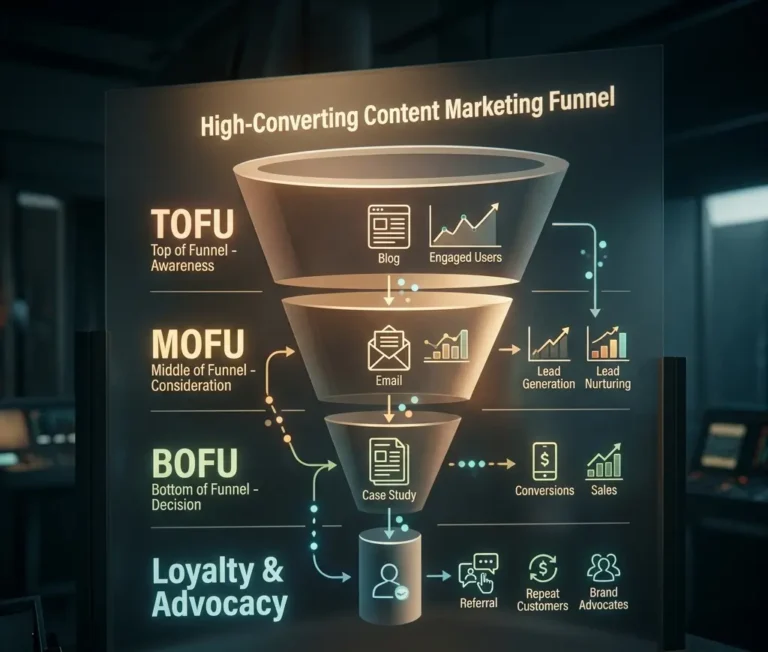
A content marketing funnel is a strategic model that depicts a potential customer’s path from their first engagement with a brand to the last stage of completing a purchase—and beyond, to long-term loyalty and advocacy. It aids companies in comprehending how to lead individuals step-by-step with tailored information that aligns with their attitude at every turn.
At the top of the funnel, customers are simply identifying a problem or becoming aware of a brand for the first time. Here, the purpose of the information is to inform, educate, or draw attention. The information becomes increasingly thorough, trust-building, and solution-focused when consumers enter the center of the funnel and start weighing possibilities and comparing solutions. Finally, at the bottom of the funnel, customers are ready to make a decision, and the material here emphasises persuasion, clarity, and a conversion-driven message.
The funnel does not end with purchase; it continues into post-buy interaction, where content fosters customer pleasure, stimulates repeat business, and converts customers into loyal advocates who actively promote the brand. In essence, a content marketing funnel visually reflects the complete relationship-building process between a company and its audience, ensuring that each piece of content plays a specific purpose in driving consumers closer to conversion and long-term loyalty.
Why Your Business Needs a Content Marketing Funnel
A content marketing funnel is no longer optional for businesses that want consistent growth—it is the backbone of a system that turns random content efforts into measurable results. Without a funnel, content frequently functions in isolation, grabbing attention but failing to direct potential buyers to a specific next step. With a planned funnel in place, each piece of content has a specific purpose in pushing prospects along, making your marketing far more strategic and effective.
A major benefit is improved lead nurturing. Instead of losing potential customers after their first interaction, a funnel helps you consistently engage them with the right content at the right time, establishing confidence gradually until they are ready to buy. This naturally leads to increased conversion rates since prospects are not just discovering your brand; they are also being informed, reassured, and guided toward a structured decision.
Shortening sales cycles is another benefit of a well-designed funnel. When customers receive accurate information at each point of their journey, they spend less time hesitating and more time taking action, eliminating friction in the decision-making process. Over time, this approach also enables automated client acquisition, in which strategically designed content attracts, nurtures, and converts leads with minimal manual involvement, resulting in a scalable growth engine for the company.
The Three Core Stages of a Content Marketing Funnel
A content marketing funnel is often divided into three primary stages: TOFU, MOFU, and BOFU, each indicating a distinct level of awareness and intent in the customer’s journey. When combined, these phases assist companies in guiding prospective clients from first-time brand discovery to a confident purchase decision.
At the Top of the Funnel (TOFU), the goal is to draw attention and raise awareness. This is where consumers are just starting to identify an issue or investigate a subject, so the information is meant to be instructive, informative, and accessible to a broad audience. Moving into the Middle of the Funnel (MOFU), the audience becomes more engaged and begins to consider potential solutions. At this point, the material starts to focus on developing trust, providing more in-depth analysis, and establishing the brand as a reliable source of solutions. Finally, at the Bottom of the Funnel (BOFU), the audience is very intent-driven and close to making a decision, so material here is geared toward conversion—addressing objections, demonstrating proof, and reiterating why your solution is the best option.
Knowing these three phases is crucial because it guarantees that your content strategy is in line with how actual customers think, assess, and make decisions rather than being arbitrary.
Demystifying the Top of the Content Marketing Funnel
The Top of the Content Marketing Funnel (TOFU) is the awareness stage, where your audience is just starting to identify a problem, explore a topic, or search for general information—not solutions. They are not yet ready to buy, and attempting to sell immediately typically pushes them away rather than attracting them.
The basic purpose of TOFU content is to connect rather than convert. It focuses on teaching, entertaining, and informing people in a way that helps them better understand their problems while quietly establishing your business as a useful and trusted source of knowledge. This is where businesses create first impressions by providing useful information such as blogs, social media postings, videos, infographics, and guides that answer broad queries and pique interest.
Instead of promoting a product or service, TOFU content builds trust at an early stage. It presents your brand as an authority that is aware of the problems that the audience faces and is prepared to deliver value without demanding anything right now. When executed properly, this phase raises awareness of both the issue and your brand as a reliable resource, laying the groundwork for further in-depth interaction in the funnel’s subsequent stages.
Best Content Types for the Top of the Content Marketing Funnel
At the top of the Content Marketing Funnel (TOFU), the goal is to attract attention, educate consumers, and raise initial awareness—so the greatest content kinds are those that are easily discoverable, highly engaging, and value-driven without being promotional.
Informational blog posts and SEO guides are one of the most powerful TOFU formats because they help your brand show up in search results when people are actively looking for answers. These articles concentrate on resolving common issues, clarifying ideas, or offering detailed instructions, which gradually increase authority and generate steady organic traffic.
Social media content and short-form videos, such as Reels and Shorts, are both effective at this stage since they attract attention quickly and perform well for people who are not actively looking but are receptive to discovery. These formats are perfect for clarifying ideas, offering fast recommendations, or addressing common pain points in an interesting and digestible manner, allowing your business to remain visible in a congested digital world.
Infographics and podcasts also play an important role in TOFU. Infographics transform complicated information into aesthetically pleasing, simple-to-understand content that works well on social media and increases shareability. Conversely, through in-depth discussions, insight sharing, and the gradual development of familiarity and trust, podcasts enable companies to engage consumers more deeply. When combined, these formats guarantee that your brand remains educational, approachable, and memorable from the very beginning of the consumer experience.
Navigating the Middle of the Content Marketing Funnel
The Middle of the Content Marketing Funnel (MOFU) is the consideration phase, where your audience has already recognised their problem and is now actively exploring possible solutions. In contrast to the awareness stage, which emphasises learning and exploration, this stage is all about assessment, comparison, and trust-building. In this case, the audience has evolved from casual readers to qualified leads who are carefully weighing their options, including your brand.
At this stage, the content’s function changes from drawing attention to fostering interest. The goal is to help prospects comprehend why a particular solution matters, how various approaches compare, and why your brand is a credible choice. This is the point at which additional in-depth, comprehensive material becomes crucial—stuff that eliminates uncertainties, provides precise answers, and exhibits competence.
MOFU content serves as a bridge between curiosity and decision-making. By providing insightful analysis, practical examples, and narratives supported by evidence that inspire confidence, it keeps prospective clients interested. This stage guarantees that leads are appropriately educated and much closer to making a purchase choice as they travel farther down the funnel.
High-Converting Assets for the Middle of the Content Marketing Funnel
In the middle of the Content Marketing Funnel (MOFU), the emphasis moves from attracting attention to captivating interest and converting engaged consumers into qualified leads. This is the stage at which trust is established, deeper value is offered, and users are encouraged to exchange contact information for more thorough, solution-oriented material.
E-books, whitepapers, and thorough ultimate guides are among the most valuable MOFU assets since they provide in-depth knowledge that goes beyond the surface. These formats help audiences clearly comprehend their problem, investigate structured solutions, and evaluate approaches in detail. In exchange for this high-value content, visitors are frequently prepared to offer their email or contact information, making them ideal lead magnets.
Webinars and interactive quizzes enhance this stage’s engagement and personalisation. Webinars enable brands to directly transmit expertise, answer queries in real time, and strengthen their authority through live interaction. Interactive quizzes, on the other hand, allow users to self-assess their wants or issues, subtly leading them towards appropriate solutions while collecting essential lead data in a non-intrusive manner.
Case studies and newsletters also play a crucial role in MOFU. By demonstrating how a product or service has resolved comparable issues for others, case studies offer actual evidence of success, greatly lowering uncertainty and boosting confidence. Newsletters facilitate ongoing engagement by consistently delivering insights, updates, and value-driven content, keeping the brand top-of-mind as prospects move closer to a decision. When combined, these resources guarantee that prospective clients are actively nurtured toward conversion readiness in addition to being informed.
Mastering the Bottom of the Content Marketing Funnel
The Bottom of the Content Marketing Funnel (BOFU) is the decision stage, when prospects are no longer exploring or evaluating but are ready to act. Because it directly affects conversion—converting qualified leads into paying customers—this stage of the funnel is the most crucial. At this point, the content’s goal is to dispel last-minute uncertainties, reduce conflict, and provide a convincing argument for why selecting your solution is the best course of action rather than to impart general knowledge.
BOFU content works by boosting confidence and lowering hesitancy. At this point, prospects frequently compare their options in search of clarity, assurance, and confirmation. Any remaining barriers—whether related to pricing, trust, performance, or suitability—must be handled with precision. At this point, the information becomes extremely action-oriented, convincing, and targeted.
Credibility and decision support are key components of strong BOFU material. It offers distinctive value propositions, emphasises differentiators, and reassures people with proof in the form of endorsements, reviews, and actual outcomes. By making sure the prospect has all they need to proceed without second-guessing, the intention is to make the decision seem clear and risk-free.
Finally, mastering BOFU entails developing content that firmly bridges the gap between interest and purchase, leading the audience from contemplation to conversion with clarity and trust.
Essential Content for the Bottom of the Content Marketing Funnel
At the Bottom of the Content Marketing Funnel (BOFU), the audience is at the ultimate decision-making stage, where intent is high, and hesitation is minimal—but still present. This is where the appropriate content may help eliminate last-minute concerns and confidently guide prospects to conversion.
Product demos and free trials are among the most successful BOFU assets since they allow potential clients to try out the solution firsthand. Instead of simply reading about features, users can interact with the product, grasp its real-world value, and see how it meets their individual requirements. This practical experience greatly lowers uncertainty and boosts confidence in the decision to buy.
Comparison guides, such as “Our Brand vs. Competitor,” help prospects who are actively evaluating multiple options. These resources make it simpler for users to see why a particular solution could be more appropriate for them by emphasising variations in features, cost, performance, or support. When done transparently and properly, comparison content can have a significant impact on final decisions.
Customer testimonials, video reviews, and pricing sheets all play an important role in BOFU. Testimonials and video reviews give social proof by displaying real-life experiences from delighted clients, hence increasing credibility and emotional confidence. Meanwhile, pricing documents provide clarity and transparency, eliminating any concerns regarding cost or value. When combined, these resources reduce conflict, strengthen confidence, and make the last stage of the purchasing process seem simple and reasonable.
How to Map Relevant Content to Your Content Marketing Funnel
- Audit your existing content assets: Gather everything of your content that has been published, including blogs, videos, case studies, social media postings, landing sites, and instructions. Sort them by performance, topic, and type to see what you already have.
- Identify the purpose of each content piece: Evaluate what each asset strives to achieve—awareness, consideration, or conversion—based on the goal it performs rather than just its format.
- Map content to funnel stages (TOFU, MOFU, BOFU): Align each asset with the buyer’s journey: TOFU for awareness and education, MOFU for evaluation and trust-building, and BOFU for decision-making and conversions.
- Analyze gaps in your funnel: Check if any stage is underrepresented. For example, great TOFU content but weak BOFU assets, or a lack of MOFU nurture content that connects the journey.
- Identify overlapping or underperforming content: Remove redundancy or update content that targets the same intent repeatedly without adding value.
- Optimize internal linking between stages: Connect TOFU content to MOFU resources and MOFU to BOFU pages, creating a smooth pathway that guides users through the funnel.
- Refine and repurpose existing content: Turn high-performing TOFU content into lead magnets, or expand MOFU content into detailed BOFU assets like case studies or comparison pages.
- Continuously monitor and update mapping: Regularly review performance metrics to ensure each piece of content is effectively moving users toward conversion.
Key Metrics to Track the Success of Your Content Marketing Funnel
Tracking the appropriate metrics at each level of your content marketing funnel is critical for determining how well your content drives prospects from awareness to conversion. Since each funnel stage serves a unique purpose, success should be measured using stage-specific KPIs rather than a generic method.
TOFU (Top of Funnel) Metrics: Measuring Awareness
- Website Traffic: Tracks the number of visitors discovering your content through search engines, social media, or other channels.
- Impressions: Measures how often your content appears in search results, social feeds, or online platforms, indicating overall visibility.
- Social Shares: Shows how frequently users share your content, helping assess its relevance, engagement, and reach.
MOFU (Middle of Funnel) Metrics: Measuring Engagement and Lead Generation
- Click-Through Rate (CTR): Indicates how effectively your content encourages users to take the next step, such as downloading a resource or visiting a landing page.
- Form Submissions: Tracks the number of users who provide their contact information in exchange for gated content, webinars, or other lead-generation assets.
- Lead Quality: Evaluates how relevant and sales-ready your generated leads are, helping determine whether your content is attracting the right audience.
BOFU (Bottom of Funnel) Metrics: Measuring Conversions and Revenue
- Conversion Rate: Measures the percentage of leads who complete a desired action, such as making a purchase, booking a consultation, or requesting a demo.
- Customer Acquisition Cost (CAC): Calculates how much it costs to acquire a new customer through your content marketing efforts.
- Return on Investment (ROI): Assesses the revenue generated compared to the cost of creating, distributing, and managing content, helping determine the overall effectiveness of your funnel.
By tracking these indicators across each stage of the funnel, businesses can recognise strengths, detect bottlenecks, and repeatedly optimize their content strategy to generate better engagement, enhanced conversions, and greater marketing ROI.
Common Mistakes When Building a Content Marketing Funnel
Even the best-planned content marketing funnel can underperform if basic errors are ignored. Understanding these dangers can assist organisations in creating a smoother customer journey, increasing conversions, and maximising the return on their content investment.
- Selling Too Aggressively at the Awareness Stage: One of the biggest mistakes is pushing products or services too early. At the TOFU stage, audiences are looking for information and solutions to their problems—not sales pitches. Overly promotional content can drive potential customers away before trust is established.
- Creating Content Without a Funnel Strategy: Many businesses publish blogs, videos, and social media posts consistently but fail to connect them to a larger customer journey. Without a clear funnel structure, content may attract traffic but struggle to generate meaningful leads or conversions.
- Ignoring Search Engine Optimization (SEO): Even high-quality content can fail if it is not optimized for search engines. Neglecting keyword research, on-page SEO, internal linking, and search intent can limit visibility and reduce the ability of content to attract qualified traffic organically.
- Failing to Capture Leads in the Middle of the Funnel: Businesses often focus heavily on awareness content but miss opportunities to collect contact information through lead magnets, webinars, newsletters, or gated resources. Without lead capture mechanisms, potential customers can leave without progressing further.
- Not Creating Enough BOFU Content: Some brands generate significant traffic and engagement but lack conversion-focused assets such as product demos, comparison pages, pricing information, testimonials, or case studies. This creates friction for prospects who are ready to make a decision.
- Neglecting Post-Purchase Content: The customer journey doesn’t end after a sale. Failing to provide onboarding content, customer support resources, newsletters, loyalty programs, or engagement campaigns can reduce retention and limit opportunities for repeat business and referrals.
- Ignoring Data and Performance Metrics: Building a funnel without tracking performance makes optimization nearly impossible. Monitoring metrics such as traffic, lead generation, conversion rates, CAC, and ROI is essential for identifying what is working and where improvements are needed.
- Creating Content for Everyone Instead of a Target Audience: Broad, generic content often struggles to resonate with potential customers. A successful funnel is built around the specific needs, challenges, and interests of a clearly defined audience.
Avoiding these typical errors helps guarantee that every piece of content serves a function, directs prospects efficiently through the buyer’s journey, and contributes to long-term business growth.
Scaling Growth with a Digital Marketing Agency in Kerala
Building a successful content marketing funnel entails more than just providing content; it also involves strategic planning, audience awareness, data-driven optimisation, and consistent execution at all stages of the buyer’s journey. Working with the proper specialists can be crucial for companies trying to grow sustainably.
This is where The Leeway Media distinguishes itself as a trustworthy digital marketing agency in Kerala. With a thorough understanding of both local consumer behaviour and international digital marketing best practices, The Leeway Media assists companies in developing effective content marketing funnels that draw in, nurture, and convert the appropriate audience. The team guarantees that your content not only reaches potential customers but also smoothly leads them to conversion by fusing sophisticated SEO techniques with localised market expertise.
From awareness-based content and lead generation campaigns to conversion-oriented landing pages and automated fostering workflows, The Leeway Media creates comprehensive funnel strategies customised for your business goals. As a results-driven digital marketing agency in Kerala, the company focuses on developing scalable marketing systems that work around the clock, assisting clients in generating qualified leads, improving conversion rates, and maximising return on investment.
Whether you’re a developing startup or an established company trying to improve your online visibility, The Leeway Media has the knowledge to transform content into a predictable growth engine using a well-structured and optimised content marketing funnel.
Automated Tools to Manage Your Content Marketing Funnel
By integrating the right tools, businesses can create a seamless customer journey that moves prospects from awareness to conversion with minimal manual effort.
- HubSpot: An all-in-one marketing, sales, and CRM platform that helps businesses manage content, capture leads, automate email workflows, track customer interactions, and monitor funnel performance from a single dashboard.
- Mailchimp: A powerful email marketing and automation tool that enables businesses to nurture leads through targeted email campaigns, personalized customer journeys, and automated follow-up sequences.
- Google Analytics 4 (GA4): Essential for tracking website traffic, user behavior, conversion paths, and content performance. It provides valuable insights into how users move through your content marketing funnel and where optimization is needed.
- Google Search Console: Helps monitor search visibility, keyword performance, indexing status, and organic traffic opportunities, ensuring your content remains optimized for search engines.
- CRM Tools (Salesforce, Zoho CRM, HubSpot CRM): Customer Relationship Management platforms help organize lead information, track interactions, manage sales pipelines, and ensure no potential customer falls through the cracks.
- SEMrush or Ahrefs: Advanced SEO tools that assist with keyword research, competitor analysis, backlink monitoring, and content optimization to drive qualified traffic into the top of the funnel.
- Buffer, Hootsuite, or Meta Business Suite: Social media management platforms that allow businesses to schedule content, monitor engagement, and maintain consistent visibility across multiple channels.
- Typeform or Google Forms: Useful for creating lead capture forms, surveys, assessments, and interactive quizzes that support middle-of-funnel engagement and lead generation.
- Hotjar or Microsoft Clarity: User behavior analytics tools that provide heatmaps, session recordings, and user interaction insights to identify friction points and improve conversion rates.
- Zapier: An automation platform that connects different marketing tools and automates workflows, ensuring data flows smoothly between your CRM, email marketing software, lead forms, and analytics platforms.
Together, these tools provide a potent ecosystem that automates the activities of lead generation, nurturing, tracking, and conversion.
Post-Purchase Strategies Within the Content Marketing Funnel
Many businesses consider conversions to be the end of a content marketing funnel, but the journey does not finish there. The post-purchase period is critical to enhancing client retention, loyalty, and lifetime value.
Businesses should concentrate on maintaining client engagement following a transaction by providing onboarding content, product manuals, useful resources, and tailored follow-ups that improve the customer experience. Relationships are strengthened, and repeat business is encouraged through loyalty-driven content, special offers, and consistent communication.
Referral programs can broaden the funnel by encouraging satisfied consumers to promote your business to others, resulting in high-quality leads via trusted word-of-mouth marketing.
The ultimate objective is to make consumers brand advocates. Customers are more likely to write reviews, give testimonials, and spread the word about your company among their networks when they have positive experiences, valuable information, and continuous interaction. A good content marketing funnel goes beyond conversion, resulting in committed customers who fuel long-term business growth.
Actionable Steps to Audit Your Existing Content Marketing Funnel
- Review Your Content by Funnel Stage: Sort all current content into three categories: TOFU, MOFU, and BOFU. Determine whether your awareness, consideration, and conversion-focused assets are in balance.
- Analyze Traffic and Engagement Metrics: Examine the material that generates the greatest interaction, clicks, shares, and traffic. A funnel leak could be indicated by high traffic and poor advancement.
- Evaluate Lead Capture Opportunities: Ensure your blogs, landing pages, and resources include clear CTAs, forms, or lead magnets. If visitors consume your material but do not become leads, you are most certainly missing out on conversion possibilities.
- Track User Movement Through the Funnel: Use technologies such as Google Analytics and your CRM to determine where prospects drop off. Identify pages with high exit rates or phases where leads have stopped progressing.
- Assess Conversion and ROI Performance: Examine conversion rates, customer acquisition costs (CAC), and revenue generated by your content. Concentrate on enhancing underperforming assets and expanding content that produces quantifiable commercial outcomes.
Following this fast audit will help you discover weak places in your content marketing funnel and identify immediate possibilities to enhance lead generation, conversions, and overall marketing ROI.
Final Thoughts on Optimizing Your Content Marketing Funnel
Most importantly, focus on delivering the right content to the right audience at the right time. When your content aligns with user intent across every stage, your funnel becomes more than a marketing framework—it becomes a scalable system for generating leads, increasing conversions, and driving sustainable business growth. By consistently testing, analyzing, and refining your approach, you can transform your content marketing funnel into a powerful engine that delivers measurable results year after year.
A successful content marketing funnel is not created overnight—it is constantly modified through testing, analysis, and optimisation. From attracting the correct audience at the awareness phase to cultivating leads during evaluation and driving conversions at the decision stage, every piece of content should have a specific objective within the buyer’s journey.
The secret to sustained success is realising that your funnel is never fully “finished.” Customer behaviour changes, market trends shift, and new opportunities emerge. Regularly monitoring performance indicators, detecting bottlenecks, updating content, and trying out new techniques will help keep your funnel effective and competitive.
Conclusion - Content Marketing Funnel
A well-structured content marketing funnel is the foundation for converting website visitors into loyal customers. By providing the right content at each phase of the buyer’s journey—from awareness and consideration to conversion and retention—you can build trust, nurture leads, and drive consistent business growth. The goal is to regularly evaluate performance, discover gaps, and fine-tune your approach to fit changing consumer wants and market trends.
If your content is driving traffic but not converting, it may be time to optimise your funnel. The Leeway Media, the best digital marketing agency in Kerala, specialises in building data-driven content marketing funnels that attract the relevant audience, produce quality leads, and maximise ROI. Are you ready to turn your content into a potent growth engine? Contact The Leeway Media today and let our team of professionals build a content strategy that converts.